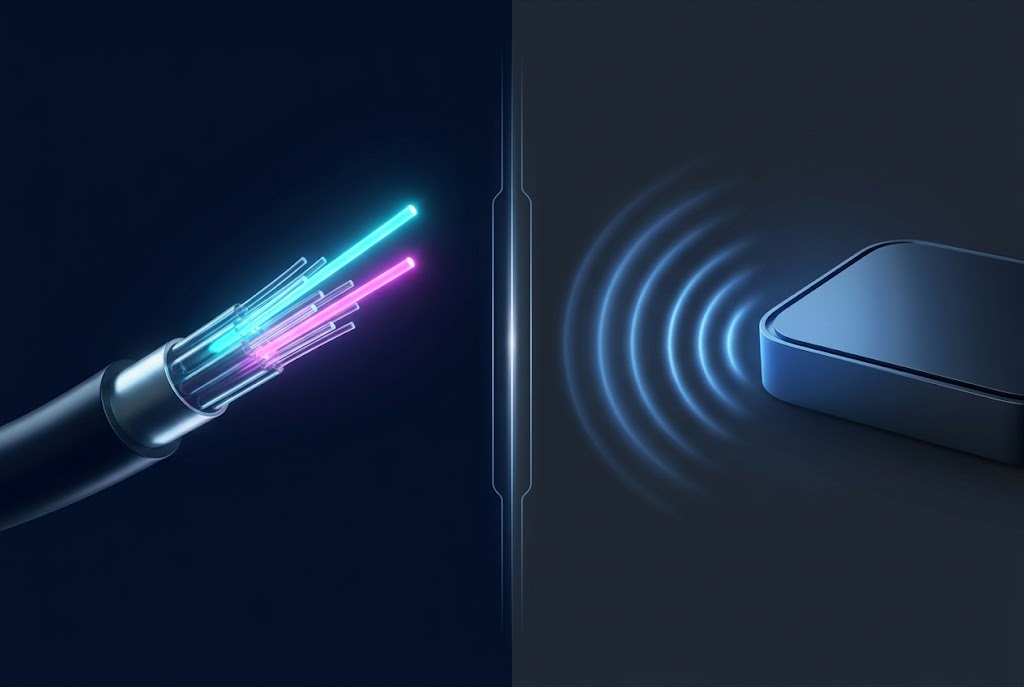
Fiber vs. 5G Home Internet: Which High-Speed Option Fits Your Area?
Fiber vs 5G Home Internet, High-Speed Internet Alternatives, Fixed Wireless Internet, Rural High-Speed Internet, Symmetrical Speeds
Fiber vs 5G Home Internet: Which High-Speed Option Fits Your Area?
If your home is still limping along on old copper cable, DSL, or weather-sensitive satellite, you already know the pain: buffering during family movie night, glitchy video calls, and uploads so slow they stall your entire connection. Fiber Connect helps homeowners, suburban residents, and edge-of-grid rural households move beyond those limits with pure fiber and, where fiber is not yet on your street, high-speed 5G home internet as a powerful fallback, delivered through our trusted network partners while you work directly with Fiber Connect for a simple, end-to-end experience.
1. The Modern Connectivity Struggle in Multi‑Device Homes
Today’s “normal” home easily runs 10–25 connected devices: smart TVs, streaming boxes, laptops, phones, tablets, gaming consoles, cameras, thermostats, and more. Legacy technologies, copper cable, DSL, and traditional satellite, were never designed for this always-on, multi-stream reality. They buckle under the load in ways you feel every day:
Constant buffering: 4K streaming and even HD video can stutter when neighbors are online, or when more than a couple of devices in your home demand bandwidth at once.
High ping and lag: Copper-based cable and DSL often show high latency, especially at peak hours. Online gaming, cloud apps, and video calls become choppy or delayed.
Throttled uploads: Legacy plans typically reserve most of their bandwidth for downloads and starve uploads. That might have worked in 2008, but not in a world of video conferencing, cloud backups, and smart security cameras.
Weather and line issues: Old copper lines corrode, and many satellite systems degrade in storms, snow, or heavy cloud cover. Your connection becomes unreliable right when you need it most.
For suburban neighborhoods and rural edge-of-grid homes, the result is the same, you pay premium prices for outdated infrastructure that cannot keep up with modern demands. That is exactly what Fiber Connect is built to solve, by helping you access pure dedicated fiber where available, and high-speed 5G fixed wireless where fiber lines have not yet reached your street, all through a single, streamlined relationship with our team.
2. Option 1: Dedicated Pure Fiber for Your Home
Pure fiber is the gold standard for home internet. Instead of pushing data over decades-old copper, Fiber Connect helps you get glass fiber-optic lines directly to your home. Light signals travel through those strands at incredible speed, delivering consistent performance no matter what your neighbors are doing.
Symmetrical 1,000 Mbps: Built for Uploads and Downloads
Our flagship residential fiber option delivers 1 Gbps (1,000 Mbps) symmetrical speeds for $55/month. “Symmetrical” means your upload speed matches your download speed. That is a major upgrade from cable or DSL, where uploads are often capped at a fraction of downloads.
Stream 4K content on multiple TVs while others game or attend video calls, without congestion.
Upload large work files, back up photos to the cloud, and run security cameras 24/7 with no slowdowns.
Support remote workers and students simultaneously, even in a device-heavy household.
Zero Neighborhood Congestion and Ultra‑Low Ping
With dedicated fiber, your connection does not slow to a crawl at 7 p.m. when the neighborhood starts streaming. Fiber lines handle far more capacity than copper, and the signal does not degrade over distance in the same way. The result is consistently low latency (ping), which is critical for:
Competitive online gaming where every millisecond matters.
Real-time collaboration tools and remote desktop sessions for work.
Stable, clear video calls with clients, teachers, and family.
Transparent Pricing and Risk‑Free Setup
Fiber Connect is built around transparency and customer control. Your pure fiber service includes:
$55/month, locked-in pricing for 1 Gbps symmetrical speeds.
First month free so you can test the service in real life.
$100 Mastercard gift card as a welcome bonus after activation.
Zero contracts and waived installation fees during local buildouts.
You get high-performance, future-proof internet without being locked into long-term commitments or surprise price hikes, aligned with industry research showing fiber as the most reliable and scalable home internet option over time (see HighSpeedInternet and CNET comparisons on fiber vs 5G).
3. Option 2: 5G Home Internet as a Fixed Wireless Alternative
In areas where physical fiber lines are not yet on your street, Fiber Connect offers a strong alternative, 5G home internet (fixed wireless). Instead of running a new line to your home, a 5G signal is broadcast from a nearby cellular tower and received by an in‑home gateway device, which then creates your Wi‑Fi network.
How 5G Home Internet Works
The setup is straightforward:
A 5G tower in your area broadcasts a high-speed wireless signal.
A small gateway device in your home picks up that signal (similar to a hotspot, but purpose-built for home internet).
The gateway distributes internet throughout your home via Wi‑Fi and Ethernet.
Real-world 5G home internet can deliver speeds up to 500 Mbps under good signal conditions, according to current industry reviews (CNET, Tom’s Guide). That is a dramatic improvement over DSL and many cable plans, especially in upload performance and latency.
Quick, Non‑Invasive Setup and No Utility Line Drops
One of the biggest advantages of 5G fixed wireless is speed to installation. There is no need to trench or run exterior utility lines. In most cases, you simply plug in the gateway, position it where it receives the strongest signal, and you are online within minutes.
Fiber Connect’s high-speed fallback service typically runs around $35–$40/month, with:
Zero contracts and simple month‑to‑month billing.
Plug‑and‑play gateway you can set up yourself in minutes.
5G home internet is the best immediate alternative when pure fiber has not yet reached your address. It gives you modern speeds and lower latency than satellite or DSL now, while you wait for fiber lines to be built out on your street.

Fixed wireless 5G bridges the gap until pure fiber reaches your street.
4. Direct Comparison: Pure Fiber vs 5G Home Internet vs Legacy Cable
Factor | Pure Fiber (via Fiber Connect) | 5G Home Internet (Fixed Wireless) | Legacy Cable / DSL |
|---|---|---|---|
Download Speeds | Up to 1,000 Mbps, consistent even at peak times | Up to ~500 Mbps, varies with signal quality and tower load | Often 25–300 Mbps, heavily affected by neighborhood congestion |
Upload Speeds | 1,000 Mbps (symmetrical), ideal for video calls and cloud backups | Often 20–100 Mbps, better than DSL/cable but not symmetrical | Commonly 1–20 Mbps, easily saturated by a few uploads |
Reliability | Extremely stable, not affected by weather or electrical interference | Generally good, can fluctuate with weather, tower congestion, obstacles | Susceptible to line damage, aging copper, and heavy neighborhood usage |
Latency / Ping | Ultra‑low, ideal for gaming and real‑time work | Low to moderate, good for most uses, can spike at busy times | Often high and inconsistent, especially during peak hours |
Setup / Installation | Professional fiber drop to home, installation fees waived during buildouts | Self‑install gateway, no exterior utility work required | Typically requires technician visit, may reuse old copper lines |
Typical Cost | $55/month, first month free, $100 gift card, no contracts | Roughly $35–$40/month, no contracts, equipment included | Widely varies, often higher for lower performance, with term contracts |
Industry analyses consistently rank fiber as the most future‑proof option for high-demand homes, while 5G fixed wireless is emerging as the best alternative where fiber infrastructure is not yet present (see HighSpeedInternet and TechRadar coverage on fiber vs 5G). Legacy cable and DSL simply cannot match either option on symmetry, latency, or long-term reliability.
5. How Fiber Availability Really Works: Street‑by‑Street Expansion
Fiber is not like satellite or 5G, where a single tower can cover a wide area. Building fiber is a physical infrastructure project. Crews run main fiber lines along roads and then branch off to individual streets and homes. That is why two houses in the same neighborhood can have very different options, fiber might be on one street but not yet on the next.
Local Buildouts and Waived Installation Fees
When Fiber Connect expands into a community, we do it in planned phases. During an active buildout:
Our teams are already on your street placing fiber and connecting homes.
Standard installation fees are fully waived for new residential customers.
You can lock in $55/month pricing with no contract and enjoy your first month free.
Because fiber grids are built street‑by‑street, checking your exact address matters. Homes a few hundred feet apart can have different timelines. That is why Fiber Connect operates as an Authorized Community Enrollment Partner, we help local residents know precisely when their street is eligible and ensure they capture waived-installation promotions while crews are active nearby.
When Fiber Is Not There Yet: Use 5G, Then Upgrade
If your address is just outside the current fiber grid, Fiber Connect’s 5G fixed wireless option lets you escape DSL or satellite immediately. Then, as soon as fiber construction reaches your street, you can transition to pure fiber, keeping the same month‑to‑month flexibility and moving from “very fast” to “virtually unlimited” speeds with symmetrical 1 Gbps performance.
Choose the Right High‑Speed Option for Your Home
If you are tired of buffering, lag, and paying too much for copper-era service, you have two clear paths forward:
If fiber is on your street: Choose Fiber Connect’s pure dedicated fiber for 1,000 Mbps symmetrical speeds, ultra‑low ping, and rock‑solid reliability, $55/month, first month free, $100 Mastercard gift card, no contracts, and waived installation during local buildouts.
If fiber has not reached you yet: Use 5G home internet as a fixed wireless alternative, up to 500 Mbps, roughly $35–$40/month, plug‑and‑play setup, and no long‑term commitment, then upgrade to pure fiber as soon as your address becomes eligible.
📌 Key Takeaway: For long‑term performance and reliability, pure fiber wins every comparison. 5G home internet is the best stopgap or secondary option when fiber is not yet available, and both are major upgrades over legacy cable, DSL, or satellite.
Fiber Connect’s mission is simple, empower homeowners with transparent pricing, no contracts, and truly high-speed internet that keeps up with modern life. Whether your best fit today is pure fiber or 5G home internet, you should not have to settle for outdated copper or weather‑sensitive satellite.
Next step: Check availability for your exact address and, if your street is in an active buildout, lock in $55/month pure fiber with waived installation and your first month free. If fiber is a phase away, enroll in high-speed 5G home internet now and be first in line to upgrade to dedicated fiber as soon as it arrives.